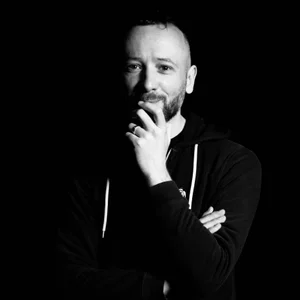
Queer Croydon Meets…Me!
Being asked to reflect on four years of work and what it meant is not something I take lightly. This interview with Queer Croydon became a kind of closing of a chapter I hadn't quite found the words for yet.
Four years of showing up with a camera. Of watching something grow from a small warm room into a real community. Of finding, for the first time, a queer family I didn't know I needed.
I don't write about myself often. But this felt worth sharing. Not because it's about me, but because it's really about what community can do to a person, if you let it.
Full interview below.
Since the very first nights of Their Majesties at The Oval Tavern in 2022, Lukasz Izdebski has been there – camera in hand – quietly documenting the birth and growth of what would become Queer Croydon. Through his lens, moments of joy, vulnerability, celebration and community have been captured with care and intention, preserving not just performances, but the feeling of belonging that has defined these spaces from the start. From drag and cabaret to community workshops and collective gatherings, Lukasz’s photography tells the story of how culture became community – and how that community grew into responsibility. In this edition of Queer Croydon Meets…, we turn the spotlight onto the artist who has helped document our journey.
You’ve been photographing Their Majesties and Queer Croydon since the very beginning. When you look back at those early nights at The Oval Tavern, what do you remember most about the atmosphere and the people in the room?
It felt small but comfortable, intimate in a way that didn’t feel accidental. I was new to the area, fresh out of lockdown and I didn’t really know anyone, but people were open and friendly from the start. By the end of that first night, everyone in the room felt like they’d attended something special. There was warmth, a cosiness, almost a family feeling. And that was true from the very first time I walked through the door. I remember Ula Lah performing for the very first time, with so many people there to support them. And Bambi Price’d Divine (though they go by a different name now) who showed me early on just how much space the night gave to different kinds of performers. The stage really was for everyone. It was chaotic, but in the most beautiful kind of way. I came as an observer that first night, not really knowing what to expect. But I immediately knew I wanted to come back and I immediately knew I wanted to document what was happening there. It was the energy, the fact that something genuinely special was taking place in that small room. I hadn’t found that family feeling anywhere else before. This was the first time.
Your photography has quietly documented the evolution of Queer Croydon — from a performance-led safe space into a wider community organisation. How did you experience that shift, and what did it mean to witness (and capture) that growth through your lens?
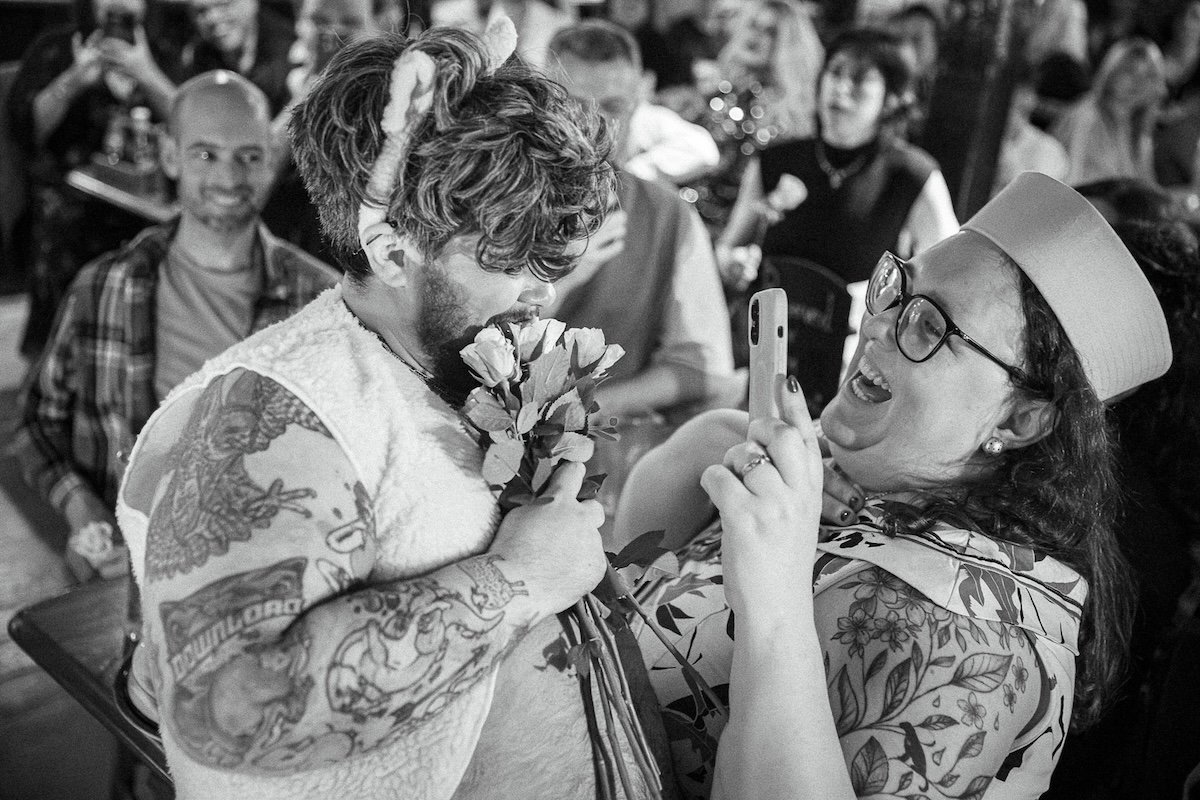
Queer Croydon evolved in response to what the community was actually asking for. There were events, performances, celebrations, but people wanted something deeper than meeting once a month over a drink. They wanted genuine connection, friendships, a place to feel truly at home and not judged. The workshops and community meet-ups that developed were a direct response to those voices and I felt that need myself too. I wasn’t just witnessing it from the outside. Documenting that shift meant being very conscious of how I worked. Performers expect to be photographed – that’s part of what they’re there for. But workshop participants, audience members, people just being themselves in a room don’t always want their faces seen, for all kinds of reasons. So I’d quietly hide in a corner, observe, try not to disrupt what was happening. The event was for them, not for my camera. Some of my favourite moments from those years are in my archive and have never been published. And I hope they will be one day. But some photographs were simply never taken. Sometimes a moment has to be a moment and doesn’t need to be widely shared or documented. Even when I did capture something, that didn’t always mean it was mine to share.What I will say is that the Special Moments during Their Majesties, where people could celebrate birthdays, name changes, divorces, new beginnings, those always moved me. There was even a couple who got engaged on stage during one of the shows. That said everything about what the space had become: somewhere people felt safe enough to mark the most important moments of their lives, together.
Photography is often about observation, but your work with Queer Croydon feels deeply embedded in the community itself. How has being part of this space influenced the way you see your role as an artist?
Before Queer Croydon, my work was more commercial and more solitary. My photography wasn’t really about people but about places, about exploration. I made connections with other queer communities during lockdown, but those things came to a natural end. It was meant to be. What changed through my involvement with Queer Croydon was that I started creating with others, collaborating, being part of something. And that completely shifted how I work. Getting to know people through conversations and through working together had a huge influence on my approach, especially when working with people in front of my camera. When you’re part of a community, you understand it. And when you don’t understand something, you know you’re safe to ask. My photography had always been about observation, but it became about something deeper: learning about other people and through them, learning about myself. We are messy and complicated and interesting, and it is so amazing to be able to witness and record that. Being able to get to know someone at a deeper level than just making a headshot is so much more valuable, so much more enriching. I don’t think I could have made this work as an outsider. You need to be genuinely present, genuinely interested in people and who they are. Someone else could photograph the same event, but understanding gives you a different insight. You notice the small things, the connections between people, the way someone feels simply by being in a room. It stops being an assignment. It becomes something you care about.
You were part of Queer Croydon’s first Executive Committee, helping shape not just how things looked, but how they functioned. What did being involved at that level teach you about community-building, responsibility, and care?
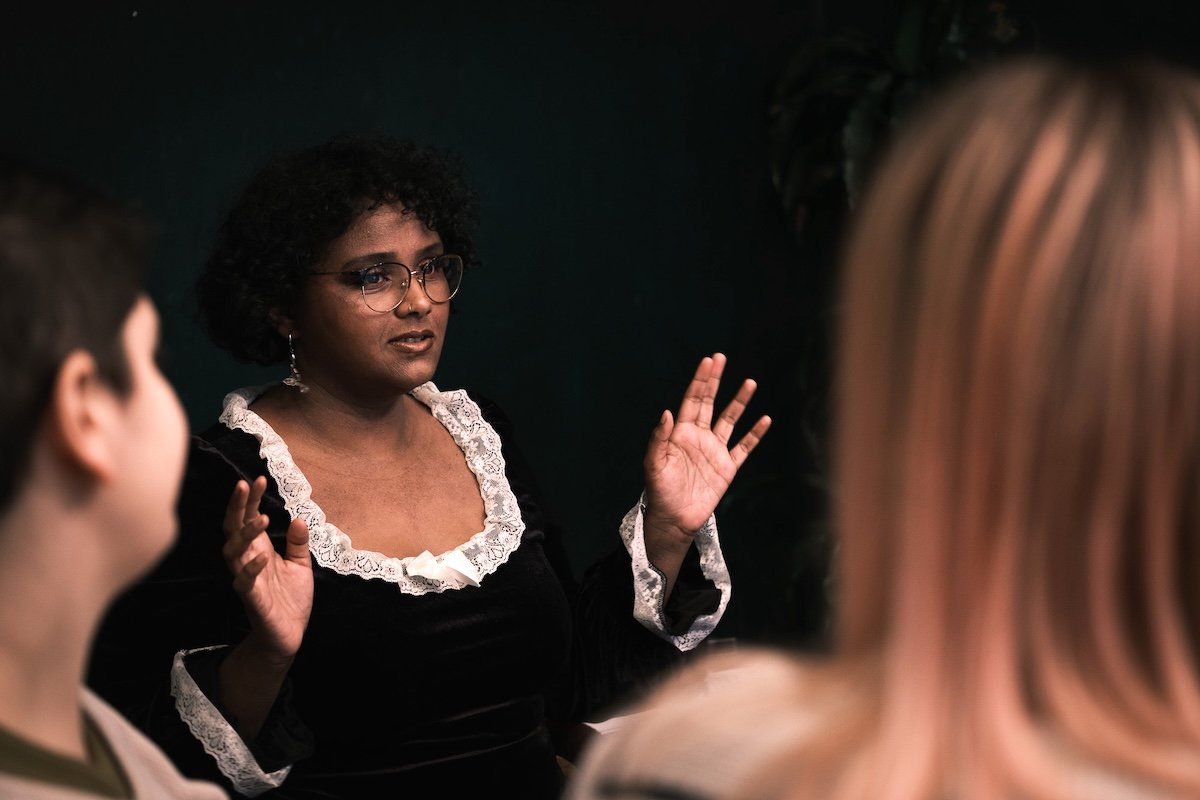
It was a fascinating time to be involved, because Queer Croydon was in the middle of transforming from something that organised fun nights and shared information, into a space where the community could really get to know each other. I contributed where I could: the website, photographing and interviewing people for features, helping with workshops and events.But the organisation is really shaped by Claudia, the chair of Queer Croydon. She has this quality I can only describe as a strict loving mother and with her direction and dedication, it became what it is today. Watching that taught me what it actually takes to hold a community together. That you need someone willing to push it forward, to make decisions, to truly understand why what you’re doing matters to people. What it taught me personally was simpler but just as important: how vital it is to show up for others. Not just as someone with a camera, but as another human being. Being part of something at that level made me understand that presence and care aren’t just nice to have, but they’re what makes a community real.
Their Majesties has always been about more than performance — it’s about belonging. Is there a moment, image, or night from Their Majesties that will always stay with you?
There are so many moments, for so many different reasons and I’m not sure I could ever choose just one. That place holds both the madness and the profound, often in the same evening. One moment I’ll never forget is watching Shepherd’s Bush perform ‘In Plain Sight’ by Self-Esteem, a song I had introduced her to. The lyrics speak about the pressure to shrink yourself, to stay silent to keep the peace. It’s something many queer people can relate to, and I certainly can. But Shepherd’s took it to another level. It was extraordinary to witness something you’d shared privately become something so powerful on a stage. And then there’s the other end of the spectrum: Mary Jane Holland performing their version of Joyride, utterly unhinged but oh so good. Merlin doing the Time Warp. Audience members writing on Mary’s dress. Shepherd’s as the Titanic. Merlin as Britney Spears. Where do you even stop? But the image that stays with me most is a quieter one. During a show where Shepherd’s wasn’t performing, Merlin and Mary decided to do a tribute to her. I photographed it from the side of the stage. To me, that image captures everything: the love that exists in that space, every single time you walk through the door.
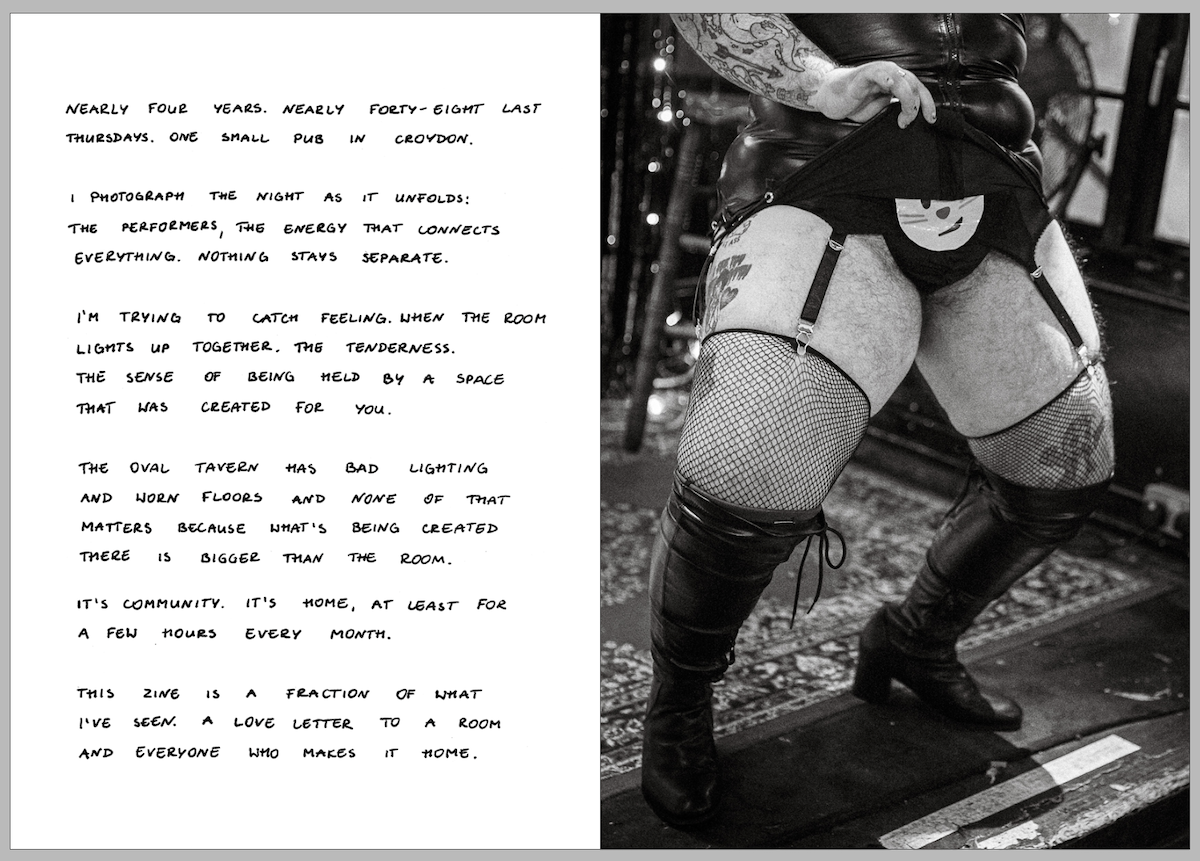
Your zine A Place For Us captures four years of queer joy, messiness, intimacy, and resistance in Croydon. What inspired you to create the zine, and what did you want it to say about this community?
At some point I found myself looking back through all the images from Their Majesties and wanted to create something that showed what this night is really about. We spend so much time looking at images on screens: they sit in front of you for a few seconds and then they’re gone. I wanted to make something physical, something people could actually hold in their hands. A short form, a snapshot rather than a full history. I wasn’t ready to make a photobook (though who knows) but a zine felt right for this moment.The title came from what the space means. A Place For Us is about how it makes people feel – safe, themselves, free – even if just for three hours once a month. It’s about a space that many people simply can’t find anywhere else. Somewhere that doesn’t ask you to shrink yourself or hide any part of who you are. ‘Us’ is about queer people, about everyone who doesn’t find that feeling in other spaces, who are expected to be something different everywhere else they go. This is a place for the queerness, for celebrating it, not hiding it. When people look through it, I hope they see all of that. The energy, the love, the community. I hope they see something I was lucky enough to notice, something that this place quietly offers to everyone who walks through the door.
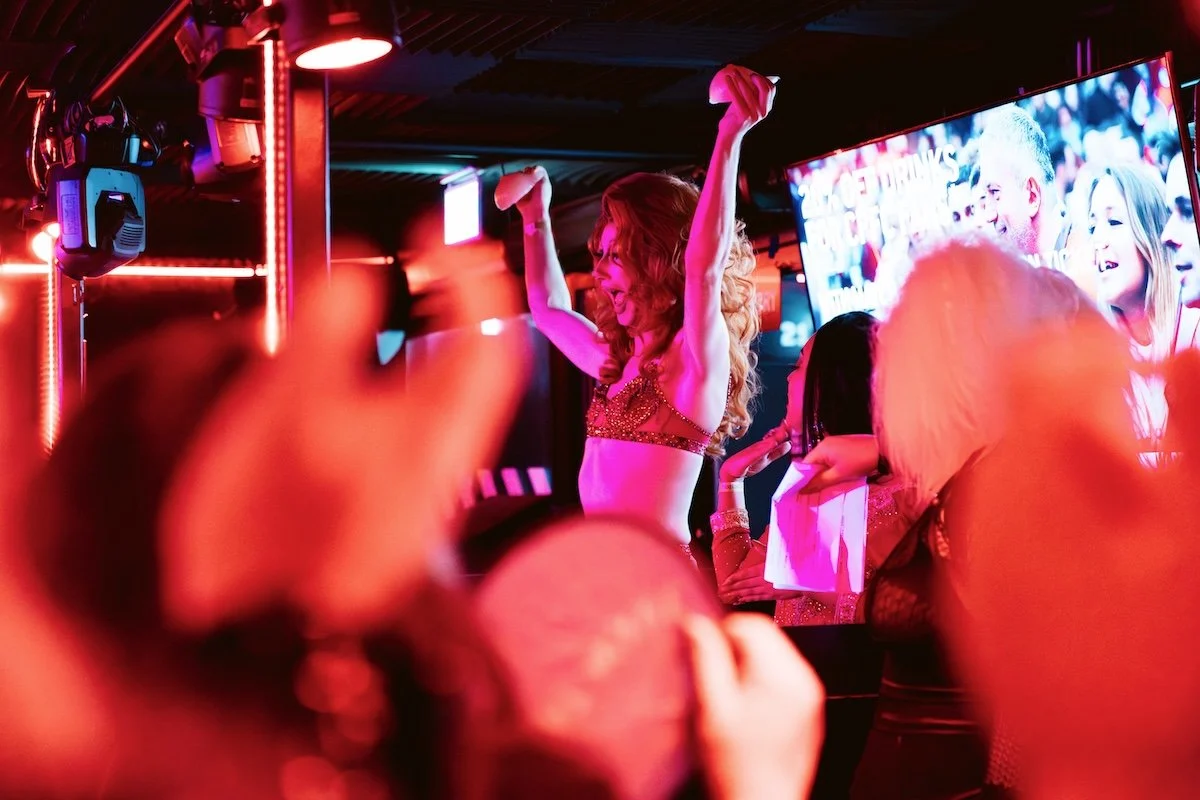
Looking through the photographs now, what do you think they reveal — not just about Queer Croydon, but about you as an artist and a person?
Looking back, I can see how I changed as I got to know everyone more. I’ve never been the most outgoing person, so this whole experience has been quite transformative. And the camera was part of that. It gave me permission to be present in a way I wouldn’t have managed otherwise. It was my way into the crowd, into people’s lives, at a level I couldn’t have reached without it. The Oval Tavern also presented its own challenge. It’s a small space, the lighting isn’t designed for performance photography and there’s simply no room to work without blocking someone’s view. So I was always thinking about how to capture something meaningful within those limitations. Looking back at those images, I can see that constraint quietly shaped my eye. I hope what comes through is my appreciation for performers, for the energy they bring to the stage and the energy the audience gives back. Live shows, music gigs, theatre – that world has always felt magical to me. Being able to document it and be part of it has been a real honour. But I also think the photographs say something about why this documentation matters beyond the moment. Queer people need to be seen, their stories need to be shared. Especially for younger queer people who might not have anything like this anywhere near them, who need to see that they are not alone. If these images do that for even one person, then they were worth making.
As your time in Croydon comes to an end and you prepare for a new chapter elsewhere, what will you carry with you from this community into what comes next?
The friendships are what I will never forget. This is where I found my queer family, people I got genuinely close to, people who matter to me deeply. Yes, I have photographs to remember these moments, but who I got to know is so much more valuable than any image.I’m also a different person than I was a few years ago. I understand myself better, and where I fit in the world. It’s still a journey, it has always been a journey, and I’m just glad I got to be part of this one. Being part of Queer Croydon has changed how I look at new places. I find myself searching for something similar, somewhere I can feel that same sense of belonging, somewhere people can truly be themselves and rely on a community around them. I don’t take that for granted anymore, because I know how rare it is. And it has shaped where I want my work to take me, what I want to make, how I want to make it and who I want to make it for.
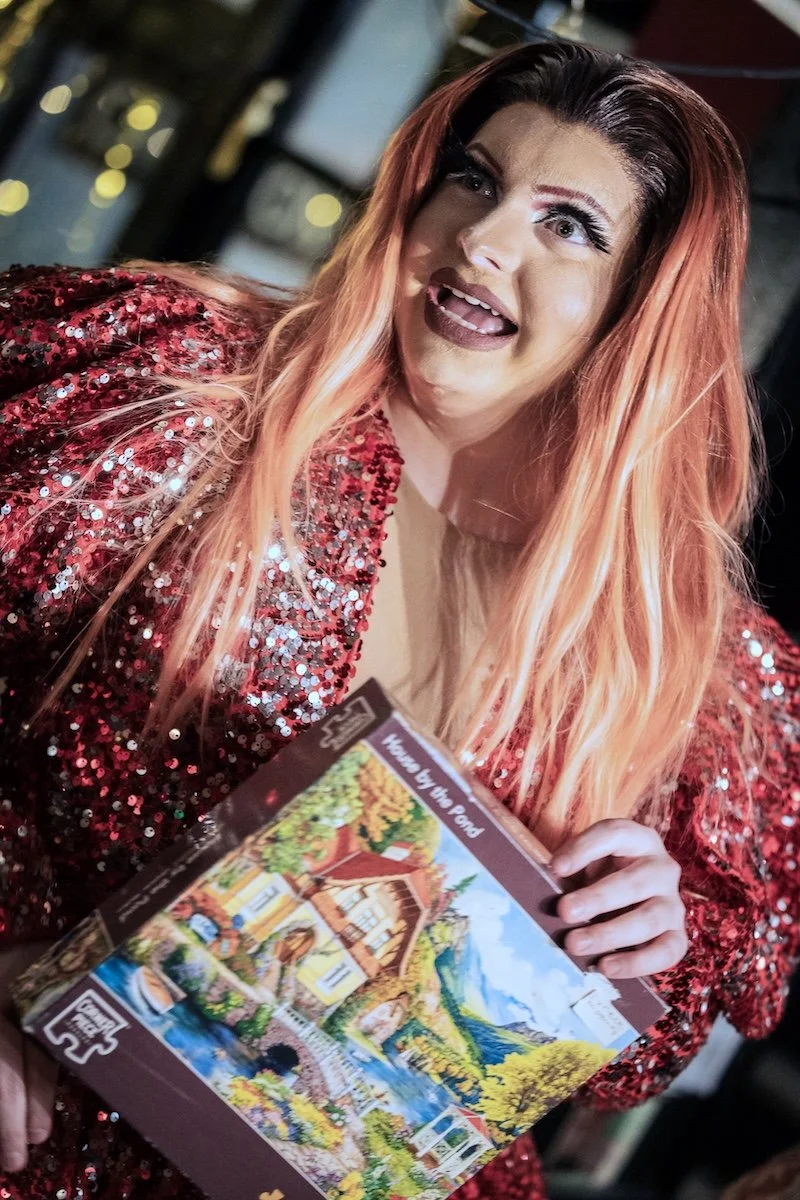
If you could say one thing to the Queer Croydon community — the performers, volunteers, audiences, and organisers you’ve photographed over the years — what would it be?
Look after yourselves and look after each other. Keep doing what you’re doing, even on the nights when it doesn’t feel like enough, even when it’s hard. What you have built is rare and it matters more than you know. Be your fabulous selves. Don’t let anyone, ever, tell you that you are not who you are meant to be. It has been the greatest honour to witness you, to document you and to be one of you.
PS. If you’d like to stay in touch, you can find me on Instagram @excusemylens or through my website www.lukaszizdebskiphoto.com – I’d love to hear from you.
And if queer storytelling matters to you, I’ll be sharing more images and stories from these years very soon. I’m building something new, and if you’d like to be part of it then I would love to have you along for the next chapter.